Overview
In the wake of the late-2000s global financial crisis, there is an increased focus on the role of the audit committee and information disclosed in an organization’s financial statements. Clearly, the audit committee’s role in ensuring accurate and transparent disclosure is more difficult and challenging than ever—given increased expectations by shareholders, regulators, and other stakeholders; heightened scrutiny when things go wrong; more responsibility for risk management; and more focus on the need for fraud prevention.
R594,72
Item No.: 5000-4
ISBN: 978-0-89413-708-2
Publisher: The IIA Research Foundation
Publish Date: June 2011
Authors: PricewaterhouseCoopers LLP
Media: Paperback
Page count:
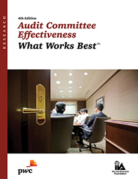
Audit Committee Effectiveness: What Works Best, 4th Edition, is intended to be a practical guide, providing information and best practices on topics that are most relevant to the audit committee to enhance performance and effectiveness. This publication:
· Provides insights and points of view from audit committee members, financial reporting experts, governance specialists, and internal audit directors.
· Incorporates survey trends, allowing you to understand the financial reporting environment and how audit committees are responding.
· Includes an Audit Committee Self-assessment Guide that captures the leading practices discussed in the report to aid in assessing audit committee performance and identify process changes to consider.
The bottom line is that people expect more from audit committees today, and this publication provides insight into leading practices that can help committees meet those expectations.
ABOUT THE AUTHORS
Catherine L. Bromilow, CPA, is a partner in PwC’s Center for Board Governance.
She works with boards of directors and audit committees of major companies and institutions, providing insight on leading practices. She has worked extensively with boards and directors from a number of countries, including the Bahamas, Barbados, Bermuda, Brazil, Canada, Israel, Mexico, the United States, and Venezuela. For the past 13 years, Catherine has been active in researching and advising on matters relating to board-level governance. She oversees numerous publications for audit committees and boards, including PwC’s annual Current Developments for Directors and the quarterly periodical To the Point. She authored the second and third editions of Audit Committee Effectiveness — What Works Best, as well as Corporate
Governance and the Board — What Works Best. In 2010, for the fourth consecutive year, NACD Directorship magazine named her as one of the 100 most influential people in corporate governance in the United States. Catherine speaks frequently about corporate governance leading practices with boards and at conferences and seminars. She is a Certified Public Accountant (licensed in New Jersey) and a Chartered Accountant (from Canada) and holds a Master of Accounting degree from the University of Waterloo in Canada.
Donald P. Keller, CPA is a partner in PwC’s Center for Board Governance. He
focuses on helping corporate directors understand how to address governance challenges
and evaluate and benchmark their activities relative to leading practices. Don has 35 years of experience at PwC, serving as the lead engagement partner for several of the firm’s largest multinational clients. His experience includes working with companies on initial public offerings, mergers and acquisitions, and investigations. Don also served as the firm’s Global Software Industry Leader, actively addressing software industry issues and business practices and authoring numerous publications and articles. Don brings this insight and experience to help directors address governance challenges and understand the implications of governance developments. He also serves on the faculty of the National Association of Corporate Directors’ Director Professionalism Course. Don is a member of the American Institute of Certified Public Accountants and the Pennsylvania, Texas, New Mexico, and Colorado Societies of CPAs. He has a Bachelor of Business Administration from the University of Notre Dame. He also serves on many not-for-profit boards.
About the Authors and the Project Team
Acknowledgments
How to Use This Book
Executive Summary
Chapter 1: Financial Reporting and Disclosures
Chapter 2: Risk Management and the System of Internal Control
Chapter 3: Culture and Compliance- the Soul of Corporate Accountability
Chapter 4: Oversight of Management and Internal Audit
Chapter 5: Relationship with External Auditors
Chapter 6: What to Do When Things Go Wrong- Financial Statement Errors and Fraud
Investigations
Chapter 7: Committee Composition
Chapter 8: Meetings
Chapter 9: Supporting Committee Effectiveness- Charter, Evaluations, Resources,
and Training
Appendix A – Audit Committee Self-assessment Guide
Appendix B – Discussion Guide for Assessing Performance
Appendix C – Required Communications from the External Auditors
Appendix D – Project Method
Appendix E – Selected Bibliography and Sources
The IIA Research Foundation Donor Recognition
The IIA Research Foundation Board of Trustees
The IIA Research Foundation Committee of Research and Education Advisors
