
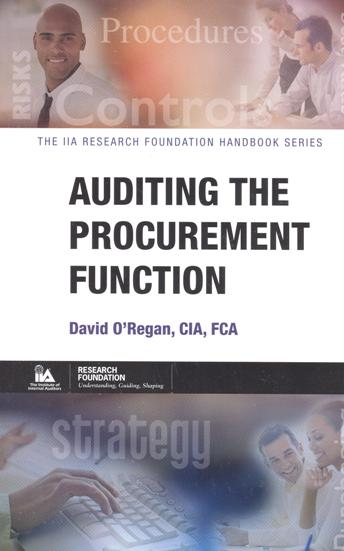
Overview
Procurement is the largest or second-largest category of expenditure in most organizations. This book offers practical advice for auditing the procurement function, and it is intended to be of relevance for all types and sizes of organizations globally—in the private sector, the not-for-profit or charitable sectors, local and national government, and international organizations.
R1012,28
Item No.: 1044-061
ISBN:
978-0-89413-622-1
Publisher: The IIA Research Foundation
Publish Date: 2008
Authors:
David O’Regan, CIA, FCA
Media: Paperback
Page count: 114
Auditing the Procurement Function is an important book for internal auditors, external auditors, and all those with an interest in the auditing of procurement (including members of audit committees, procurement professionals, and those who are subject to auditing
The book discusses:
· The definition, scope, and importance of procurement.
· The core challenge of procurement and concept of “best value for money.”
· The important risk areas of fraud, ethics, and socioeconomic factors.
· Common risks, procedures, and internal controls at different stages of the procurement process.
· Procurement strategy and planning.
· The typical sequence of events in the procurement cycle for individual transactions.
Table of Contents
TABLE OF CONTENTS
Page
Acknowledgements v
About the Author vii
Executive Summary ix
PART ONE – INTRODUCTION AND CORE CONCEPTS
Chapter 1: Defining Procurement 3
Chapter 2: The Scope of the Book 7
Chapter 3: The Core Economic Challenge of Procurement 11
Chapter 4: Best Value for Money 17
Chapter 5: Procurement and Fraud 19
Chapter 6: Ethics and Socio-Economic Issues 27
PART TWO – THE PROCUREMENT PROCESS:
PROCEDURES AND INTERNAL CONTROLS
Chapter 7: The Auditing of Basic Procedures and Internal Controls 35
Chapter 8: Procurement Strategy and Planning 37
Chapter 9: The Request for Procurement 43
Chapter 10: The Identification of Potential Vendors 47
Chapter 11: Competition 55
Chapter 12: Technical and Economic Evaluations 63
Chapter 13: Selection of the Preferred Vendor and Award of Contract 73
Chapter 14: The Receipt and Evaluation of Goods and Services 85
PART THREE – CONCLUSIONS
Chapter 15: Concluding Thoughts 93
Chapter 16: Sources of Further Information 95
Appendix – glossary 99
